
Places · San Antonio, Texas
Mission in the Rain: A Morning at San Antonio’s Historic Missions
Storm clouds chase us and bring new life to three historic sites within San Antonio’s remarkably accessible Spanish colonial missions.
Rain followed us throughout our morning at San Antonio Missions National Historical Park, but it never felt like an intrusion. Instead, the passing showers became part of the experience, changing the light, deepening the colors, and giving us a different perspective on a landscape that is often imagined as uniformly hot, dry, and sunbaked.
One minute, the sky was a flat sheet of gray. The next, sunlight slipped through a break in the clouds and spread across a limestone wall. Then the rain returned, sometimes as a soft patter and sometimes as a downpour strong enough to briefly reshape our plans.
As a photographer, I welcomed the uneven weather. Bright midday sun can flatten pale stone and wash away detail, but the storm clouds created soft, indirect light mixed with moments of sharper contrast. Shadows moved across façades, damp stone took on richer tones, and structures that might otherwise appear somewhat monochromatic changed character from one minute to the next.
The rain also made the surrounding landscape feel more prominent. Grass along the river corridor glowed green, live oaks looked darker and fuller, and the mission grounds seemed closely tied to the water that had made settlement possible here in the first place. Rather than seeing the missions as isolated stone structures in a dry Southwestern setting, we began to appreciate them as communities built within a surprisingly verdant river valley.
Under clearer conditions, we might have spent most of a day exploring all four missions south of downtown San Antonio. Instead, we made a quick tour of three, drove past a fourth during the morning’s heaviest rain, and came away with a memorable introduction to one of the city’s most significant historic landscapes.
The four missions protected within the national historical park—Concepción, San José, San Juan, and Espada—form a loose chain along the San Antonio River south of downtown. Together with Mission San Antonio de Valero, better known as the Alamo, they are part of the San Antonio Missions UNESCO World Heritage Site, designated in 2015. The group is the only UNESCO World Heritage Site in Texas.
More Than a Series of Churches
It is easy to think of the missions primarily as old churches, especially when their bell towers and carved stone façades dominate the view. In the 1700s, however, they functioned more like small, organized settlements.
Franciscan missionaries established the communities as part of Spain’s effort to expand, defend, and govern the northern frontier of New Spain. Indigenous residents lived, worked, worshipped, raised livestock, and cultivated crops within and around the mission compounds. Workshops, granaries, residences, defensive walls, farms, and irrigation channels were as important to daily life as the churches themselves.
The missions were also instruments of colonization. Their development brought new crops, technologies, trades, livestock, religious instruction, and forms of government, while placing intense pressure on Indigenous communities to abandon or modify their languages, beliefs, traditions, and ways of life. The culture that developed around the missions was neither entirely Spanish nor entirely Indigenous, and its influence remains visible across South Texas.
Their location along the San Antonio River was practical. Reliable water, fertile soil, and existing Indigenous travel routes made the valley suitable for a connected network of settlements. The Spanish and mission residents developed systems of acequias, or irrigation ditches, to divert river water toward fields and communities. Portions of those systems—including the Espada Aqueduct and working channels near San Juan—remain part of the cultural landscape today.
Our rainy visit made that relationship between water and settlement easier to understand. The corridor did not resemble the dry, dusty version of South Texas that outsiders might expect. Instead, it was green, shaded, and visibly shaped by the river. The weather helped us see why this valley, rather than the surrounding uplands, became the focus of so much activity.
An Early Stop at Mission Concepción
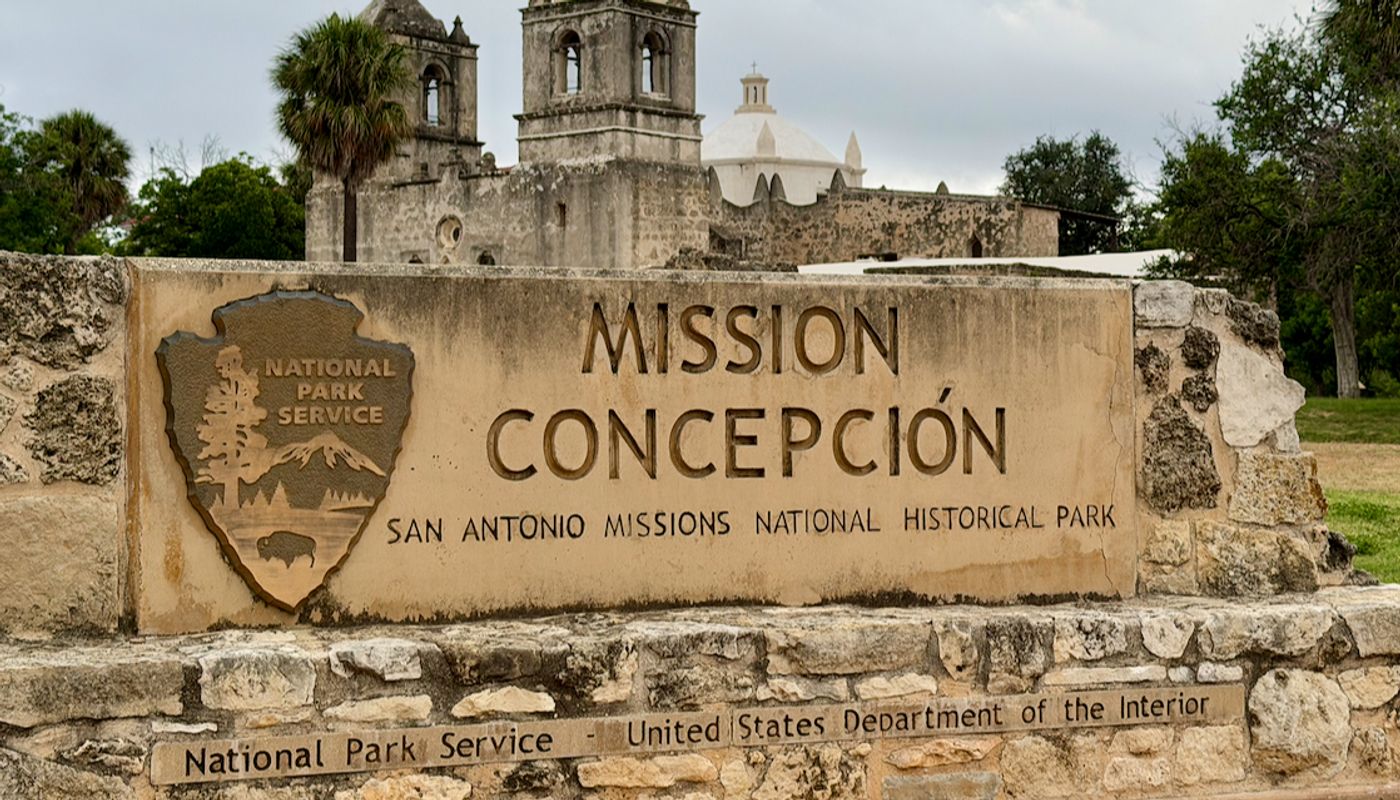
Our morning began at Mission Nuestra Señora de la Purísima Concepción de Acuña, generally shortened to Mission Concepción.
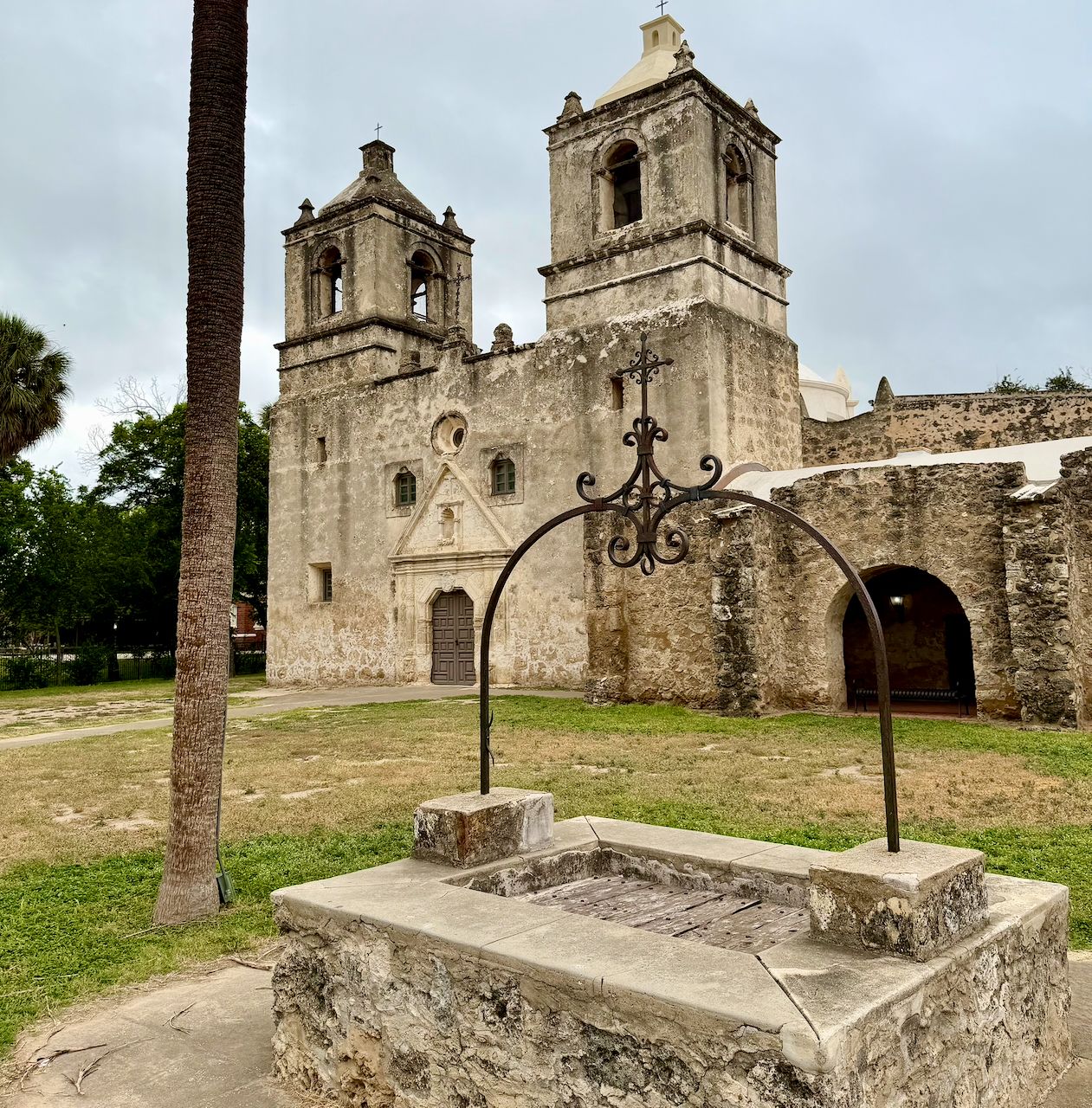
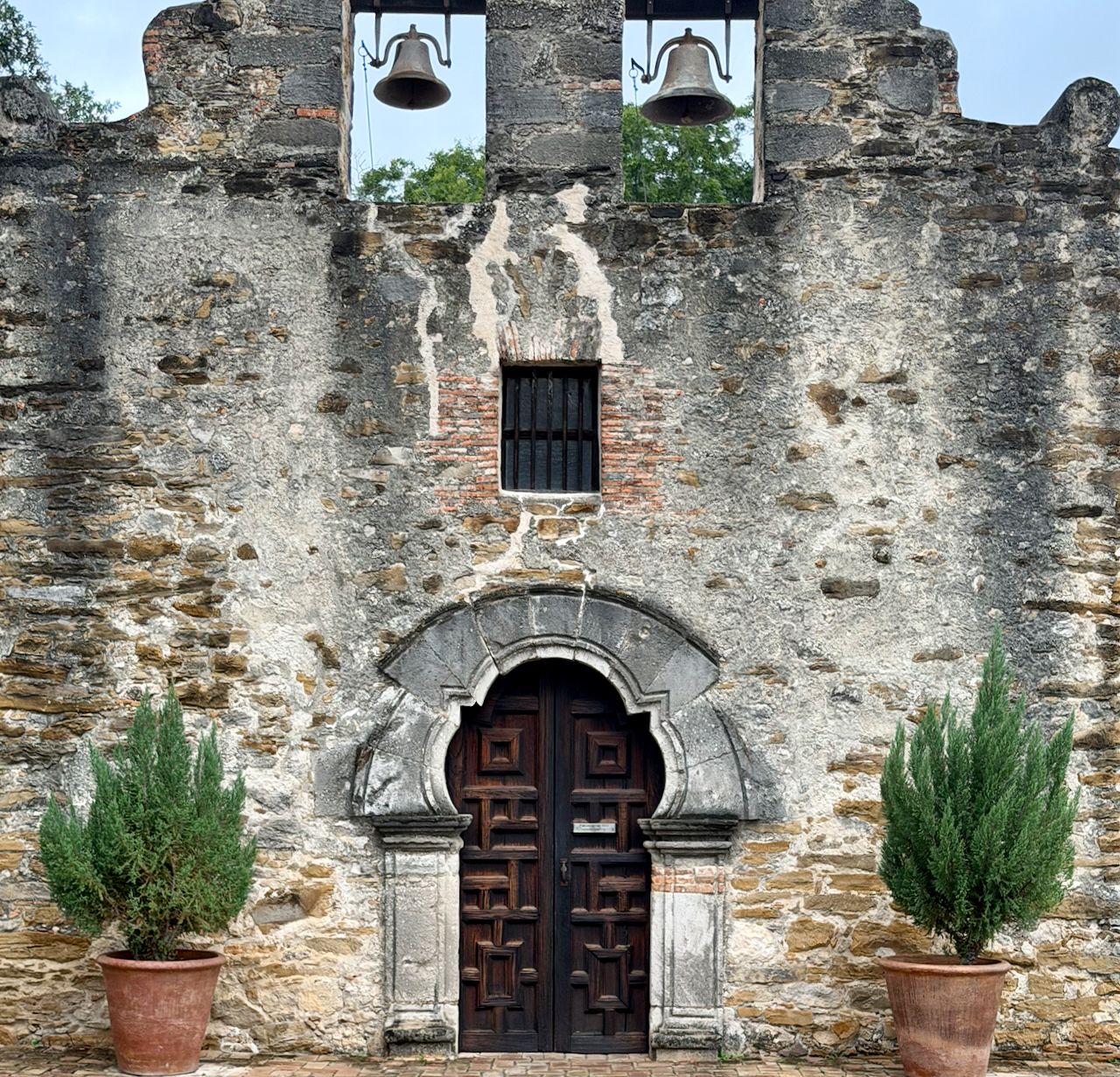
We arrived before the buildings opened, so our visit was limited to a short walk from the parking area to the front of the church and convento. Even without going inside, there was plenty to examine. The broad stone exterior felt especially substantial beneath the dark sky, and the heavy wooden doors appeared both practical and ceremonial.
The clouds softened the light across the façade, allowing the textures of the limestone and wood to stand out without the harsh glare of direct sun. Damp patches on the walls added subtle variations in color, while occasional breaks in the clouds briefly highlighted the upper portions of the church.
Mission Concepción was originally founded in East Texas in 1716 and transferred to its present San Antonio location in 1731. Its stone church took roughly 15 years to construct and was dedicated in 1755. Because the building was constructed directly on bedrock and never lost its roof, it survived with much of its structural integrity intact. The National Park Service describes it as one of the country’s oldest remaining original stone churches and the least restored of the park’s mission churches.
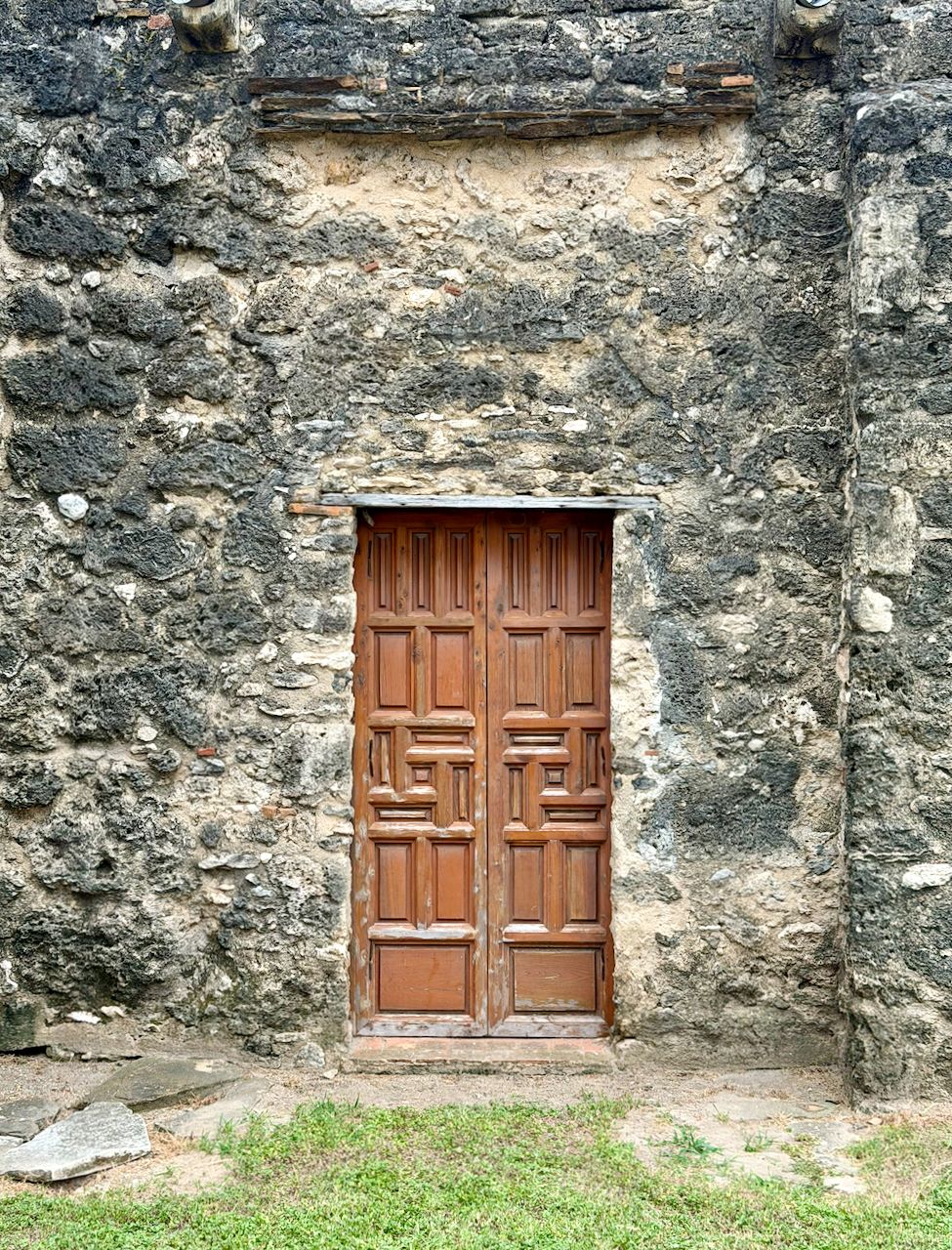
The closed doors meant we missed the remnants of colorful frescoes found inside, but the quiet grounds had their own appeal. With few visitors around and clouds shifting overhead, we could pause in front of the weathered façade without feeling hurried.
A Downpour at Mission San José
From Concepción, we continued south to Mission San José, the largest of the four park missions and home to the park’s primary visitor center.
San José was founded in 1720 and became one of the most substantial mission communities in the valley. Its scale, surviving perimeter walls, residential rooms, granary, church, and convento make it particularly useful for understanding how a mission operated as a settlement rather than simply as a place of worship.
Just as we pulled into a parking space, the sky opened into a tremendous downpour. Rain hammered the car hard enough that even the short walk toward the visitor center looked impractical. After watching sheets of water sweep across the parking lot, we made two decisions.
First, we would have to save Mission San José for another visit.
Second, the chorus of Jerry Garcia’s “Mission in the Rain” would apparently be stuck in my head for the next half hour.
Missing San José was a disappointment, but even the downpour added something to the morning. It gave the landscape a sense of movement and reminded us that water here is not merely a historical footnote. It shaped where people settled, how they farmed, and how the communities survived.
We eased back onto the road and continued south. The rain softened as we drove beside the grassy riverfront park, changing from a heavy curtain into large, widely spaced droplets. The greens looked saturated beneath the low clouds, and the river corridor felt more like a ribbon of fertile land than a route through an arid region.
Although we had bypassed the park’s largest mission, the drive itself helped reveal how closely the sites are connected.
Mission Concepción sits about three miles south of downtown. San José is roughly three miles farther, San Juan is another three miles south, and Espada is only about a mile beyond that. The entire group can be explored without leaving the urban area, yet stretches of the route feel much quieter and greener than central San Antonio.
Following the River South
We continued past portions of the river landscape and drove near the historic Espada Dam, part of the system that diverted water into the Espada Acequia.
These waterworks help explain why the missions developed where they did. The settlements required water not only for drinking but also for irrigating fields, operating farms, supporting livestock, and sustaining a growing population. The river linked the communities geographically, while the acequias made permanent agriculture more practical in a region where rainfall could be unreliable.
The rain made that history feel immediate. Water gathered along the road, leaves glistened, and the broad lawns and riverbanks looked dense and fertile. The scene challenged the simplified idea of the Southwest as a landscape defined only by heat and dryness.
South Texas can certainly be hot, and drought is part of its environmental reality, but the San Antonio River valley has long provided a more hospitable corridor. Seeing it during wet weather offered a useful reminder that settlement patterns are often easiest to understand when we look beyond regional stereotypes and pay attention to local geography.
Today, the park protects more than church buildings. Historic fields, irrigation features, archaeological remains, residences, granaries, and the associated Rancho de las Cabras are all part of the larger mission story recognized by UNESCO.
Mission San Juan and the Shape of a Village
By the time we reached Mission San Juan Capistrano, gaps had begun to open in the clouds. Sunlight struck the mission buildings in patches, brightening one wall while leaving another in shadow.
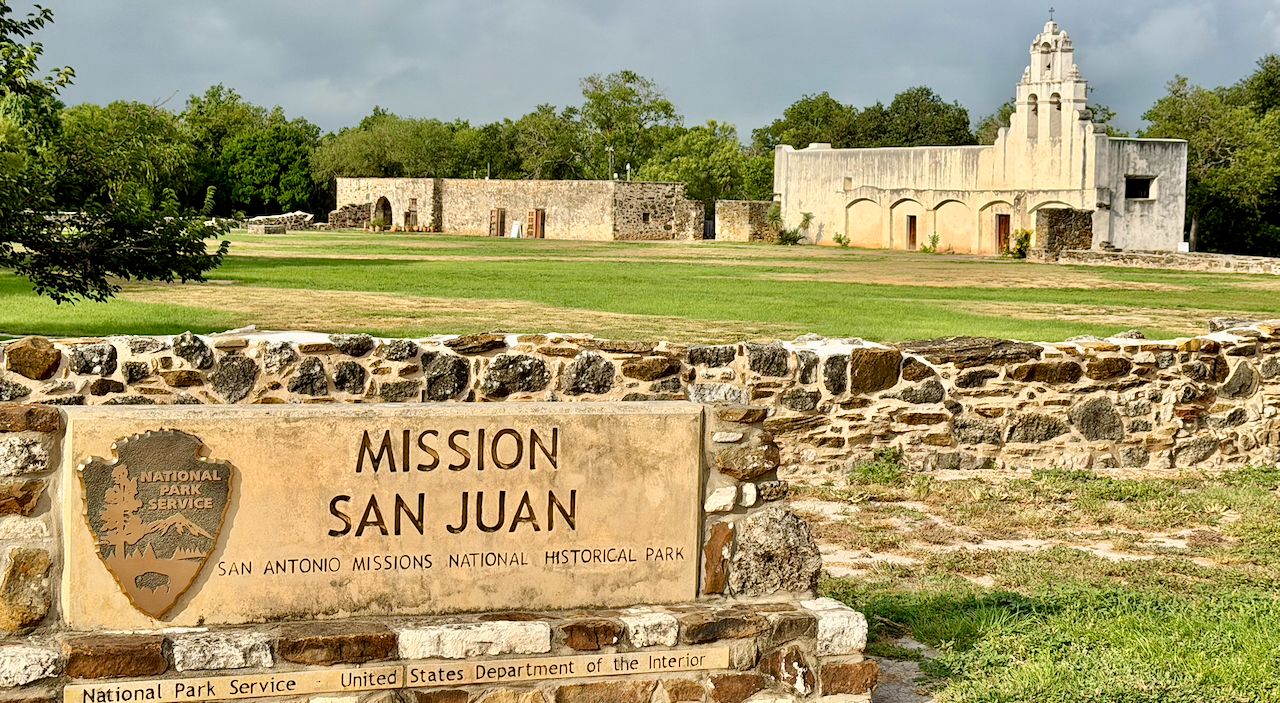
Mission San Juan was founded in East Texas in 1716 and transferred to its present location in 1731. By 1756, residents had completed a stone church, friary, and granary. A larger church was started but never finished as the mission population declined.
Of the stops we managed to explore, San Juan most clearly conveyed the sense that these missions were once small villages.
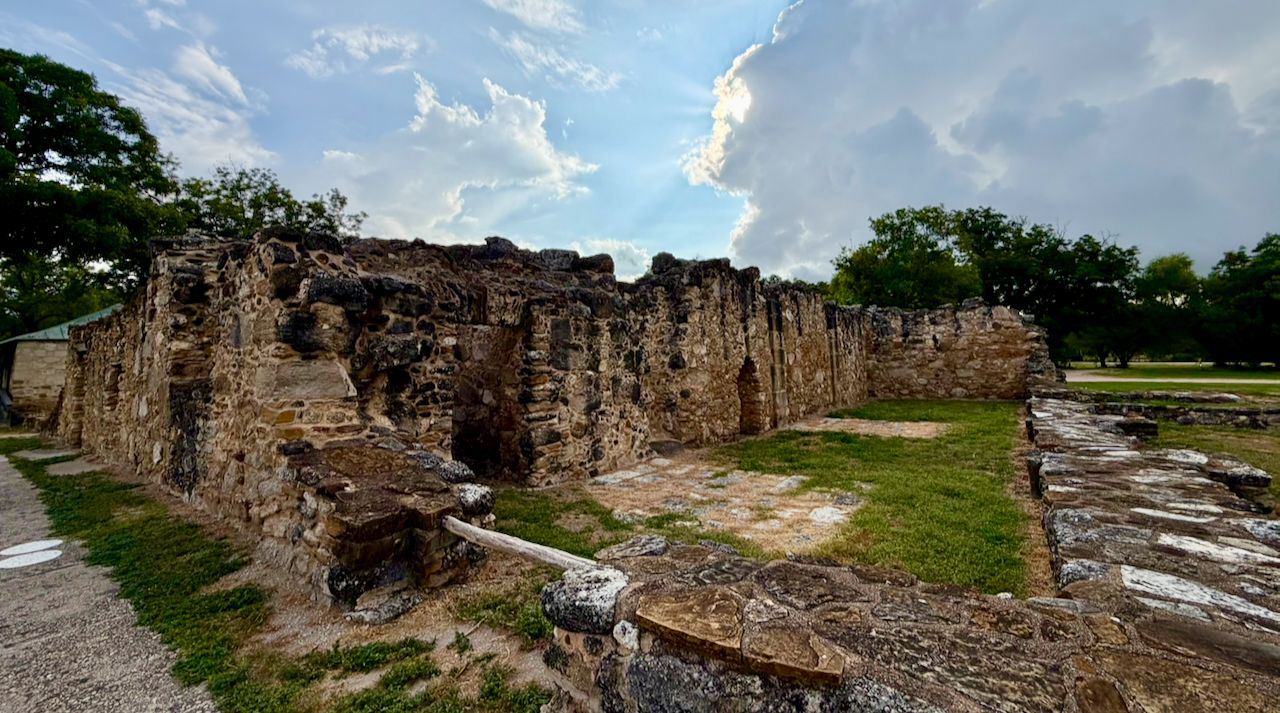
The buildings are modest in scale, and the open space around them makes it easier to imagine people moving between homes, workshops, storage areas, fields, and the church. Rather than standing apart from daily activity, the religious buildings were integrated into an agricultural community.
The weather added depth to that impression. Dark clouds hung beyond the open grounds while sunlight moved across the white church and wet grass. The contrast made the settlement feel connected to the surrounding fields rather than isolated from them.
That agricultural connection remains unusually visible at San Juan. Historic farm fields south of the mission are still in use, and the acequias continue to carry water from the San Antonio River toward the surrounding land. A short nature trail also leads toward a stretch of the river that retains more of its historic character than the developed waterways closer to downtown.
With the storm beginning to move away, San Juan felt quiet and spacious. The shifting light offered a better look at the simple church and surrounding compound before the clouds began gathering again.
A Brief Final Stop at Mission Espada
Our final stop was Mission San Francisco de la Espada, the southernmost of the four missions in the national historical park.
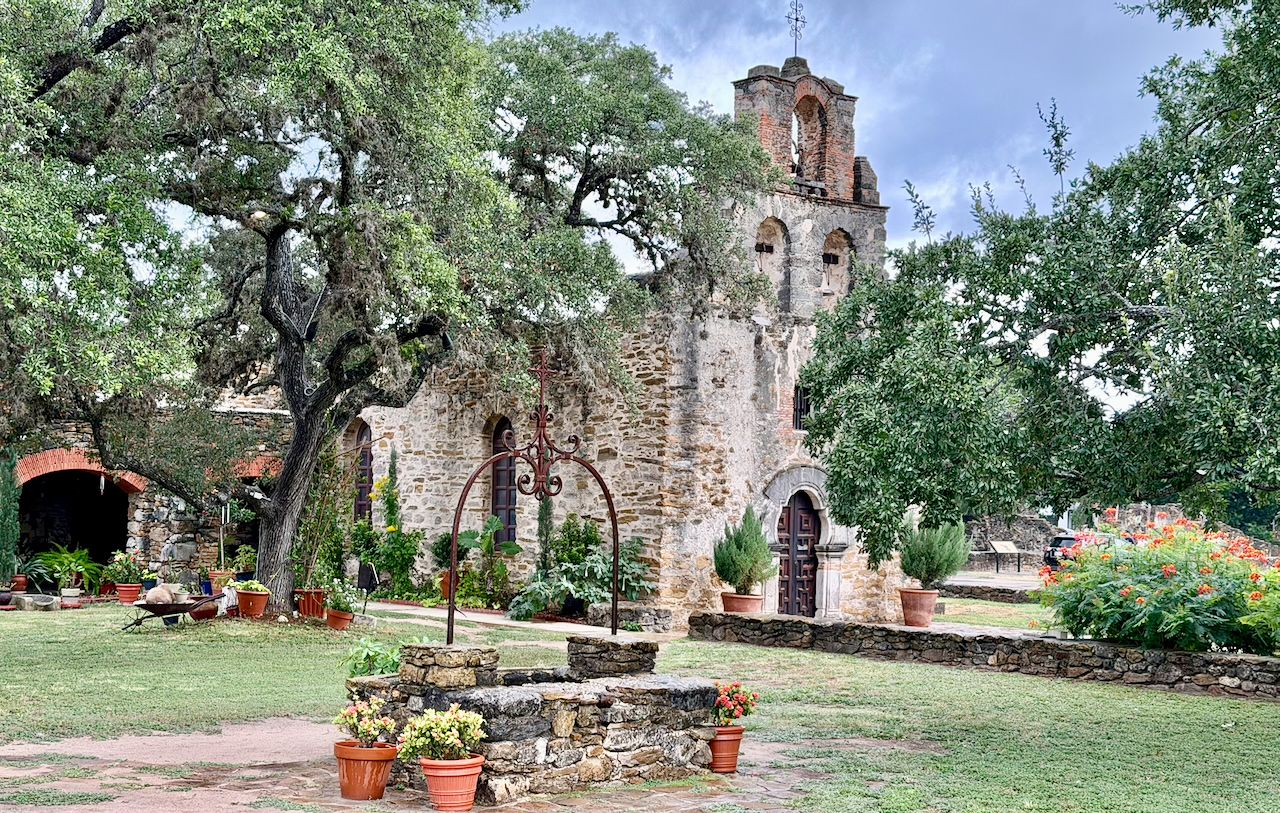
Espada’s history reaches back to 1690, when the Spanish founded Mission San Francisco de los Tejas in East Texas. After several changes and relocations, the mission was transferred to the San Antonio River valley and renamed Mission San Francisco de la Espada in 1731. Its friary was built in 1745, and the church was completed in 1756.
Our visit was short. We walked far enough to admire the picturesque convento framed by spreading live oaks and to take in the compact mission grounds.
The setting was especially appealing after the rain. The live oaks appeared almost black against the pale stone, while the wet grass and muted sky framed the convento in a way that bright sun probably would not have.
The architecture at Espada feels less imposing than Concepción and less expansive than San José, but its relative simplicity suits the quieter southern end of the mission corridor. The combination of rough stone, mature trees, and uneven storm light made it a fitting final stop.
Before long, raindrops began tapping slowly against the ground again. Rather than feeling chased away, we took it as a natural stopping point, returned to the car, and continued toward the day’s other destinations.
The Alamo and the Larger Mission Story
No discussion of San Antonio’s missions would be complete without Mission San Antonio de Valero, now known as the Alamo.
We visited the Alamo separately during an evening walk along the River Walk. Its central location, crowds, and association with the 1836 Battle of the Alamo give it a different atmosphere from the four missions south of downtown. Still, it began as part of the same Spanish colonial mission system.
The Alamo is not administered as part of San Antonio Missions National Historical Park, but it is included with the other missions in the UNESCO World Heritage designation. Seeing it alongside Concepción, San José, San Juan, and Espada places its earlier mission history back into the larger landscape of the San Antonio River valley.
Planning a San Antonio Missions Visit
San Antonio Missions National Historical Park does not charge an entrance fee. The outdoor grounds are generally accessible from sunrise to sunset, while staffed buildings and the Mission San José visitor center operate on more limited schedules. Because hours, church services, preservation work, and temporary closures may change, check the official National Park Service visitor information before setting out.
Travel Tips
Allow more time than we did. A quick driving tour provides a useful overview, but half a day is a more practical minimum for entering several buildings and exploring the grounds. A full day allows time for trails, exhibits, and irrigation features.
Begin at Mission San José. The main visitor center, introductory exhibits, and park film provide context that can make the remaining stops more meaningful.
Check opening times. The mission grounds may be accessible before the interiors open, as we discovered at Concepción. The churches remain active Catholic parishes, so access can also be affected by Masses, weddings, funerals, and other services.
Do not dismiss a rainy forecast. Showers may limit access temporarily, but cloud cover can make outdoor exploration more comfortable and bring out the colors of the landscape and stonework. Storm light is also especially useful for photography.
Protect your camera gear. Spotty showers can arrive quickly. A weather-resistant bag, lens cloth, or simple rain cover makes it easier to keep photographing when conditions change.
Bring water and sun protection. Even on a cloudy morning, South Texas weather can shift quickly, and heat can become intense once the sun returns.
Consider biking the corridor. The missions are connected through the broader Mission Reach trail system along the San Antonio River. Cycling offers a slower look at the river, restored habitat, public spaces, and historic waterworks between the sites.
Do not treat the missions only as ruins. All four churches remain active parishes, and families connected to the mission communities continue to live in San Antonio. Visiting respectfully means recognizing both the colonial history and the living communities associated with the sites.
A Different View of South Texas
We saw less of the park than we had originally planned. Mission Concepción was not yet open, San José disappeared behind a wall of rain, and the renewed patter at Espada brought our final stop to an early end.
Still, the weather improved the morning in ways we had not expected.
The rain softened the light, sharpened the colors, and drew our attention to the lush river corridor surrounding the missions. It helped us understand that these communities were not simply planted in an empty, dry landscape. They developed along a productive waterway that supported fields, livestock, homes, and trade.
The shifting storm clouds also gave each mission a different visual character. Pale limestone walls moved between shadow and sunlight, dark trees framed the buildings, and damp surfaces revealed colors and textures that might have disappeared under a clear midday sky.
We left satisfied with our quick historic tour, appreciative of the weather that had reshaped it, and with a clear reason to return for the mission the heaviest rain kept us from seeing.